My First Fifty Years
by John R Bennett
Chapter 5 - Drivers License
Insurance for individuals with no physical ailment seems to be taken for granted. My experience has taught me this is not so for individuals with diabetes.
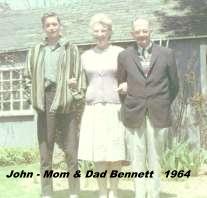
My parents moved from Pennsylvania to East Marion, Long Island the summer of 1965 while I was a counselor at Camp Joslin. When they wrote and told me, I was first astonished because I hadn't heard them mention even the possiblity of this. Secondly, I was mad. Living in Pennsylvania, a youngster is allowed his driving permit at the age of sixteen and I had already applied for my permit. Now I had to start all over again.
Coming home from camp, I was healing from my appendicitis operation. Not being able to move around much for a couple of weeks left me time to call the Motor Vehicle Dept. to have them send me paperwork for obtaining my learner's permit. For once I was almost ready to lie about my diabetes. Prior to being issued a permit, I had to prove that I was on an insurance policy. Applying for insurance caused me all sorts of hassles. The instructions stated that I was required to get letters from two physicians attesting to the fact that my diabetes would not affect my safe handling of a motor vehicle.
The family's personal physician had no problem with this as long as the permit stated that I had diabetes and was insulinˆ dependent. Dad called another doctor in town, then went to pick up his letter. My father and I didn't see eye to eye on a lot of things, but our response to that letter was a united front. The doctor had stated that because I had the possiblity of becoming unconscious behind the wheel it was his expert opinion that I should not be issued a driver's license. We found out later he had written similar letters before and did not advocate any diabetic holding a driver's license.
I finally got the letter I required from the Joslin Clinic. It angers me that there was such discrimination. I argue that controlled diabetics have less likelihood of being unconscious than an epileptic or a drunk. People who occasionally go into epileptic 'fits' have the same problem as the diabetic with insurance but an otherwise normal individual who drinks is never screened. Where on a driver's license application does it read, "Do you ever use alcoholic beverages?"
Living on a dairy farm, I had driven farm vehicles for years. Most farm lads begin driving tractors before they are ten years old. I'd driven caterpillars as well as tractor trailers before I was sixteen (off the road, of course). I took pride in how I was in control of my diabetes. Testing several times a day, taking my shots at the prescribed times, eating my meals when I should, very seldom seeing the insulin reactionsˆ any more and then only after heavy physical exercise, IMHOˆ driving didn't pose a problem to anyone. How can I convince anyone?
I left home to live on the dairy farm when I was eleven. It was on the farm I learned to get up early, 4:30 AM, to help milk cows. It was my job to put the milkers together and bring them from the milk house into the barn. There was a bull in the barn that I was warned to stay away from. He gave me my first introduction to the reproduction process.
He also scared me half to death one morning. Carrying the milkers into the barn, I had stopped to turn on the lights and I could see the bull in the middle of the aisle with his stanchion around his neck and the chains that would have anchored the stanchion to the floor and higher beams just dangling. As soon as he saw me he charged. Leaving the milkers right where they were I dove into the sawdust bin and just kept climbing. We were finally able to corner him at the back of the barn by driving the tractor down the center aisle. Once someone was able to grab his nose ring he was docile as could be.
Norm Glover, the farm owner's son, taught me how to make root beer one summer. We used old quart beer bottles we picked up at a supermarket and sterilized, added yeast to the root beer mix and we'd make, bottle, and cork about twenty-four quarts at a time. Then we'd box the bottles and store them in an empty upstairs room on the farm until they had aged. One hot summer afternoon after loading two wagons with baled hay, Norm and I came to the kitchen to get something to drink. My blood sugar was low and a glass of root beer sounded just right. Going into the refrigerator I found a bottle that had previously been opened and was nearly empty.
My father, a Baptist minister, walked in the door as I started drinking straight from the beer bottle. I immediately had to convince him that I wasn’t drinking beer, or he wouldn’t have let me stay on the farm. As we're "visiting" we started hearing what we thought was a car backfiring. First one, then seconds later another. Within three minutes we had lost count. Twenty minutes later we watched as root beer began dripping from the kitchen ceiling. Maybe we used a little too much yeast? What a mess.
Norm and I joined a men's bowling league in Hancock, N.Y., which was about fourteen miles from the farm by road. On Wednesday nights during the winter months we'd let Norm's mother & father finish milking without us. When there was snow on the ground it was easier and faster to drive the snowmobile over the mountain to the bowling alley instead of going by car on the roads. The only problem was when it started getting cold and we had to come back over that mountain with the wind blowing over thirty miles an hour and a wind-chill factor of -20. We had many bone chilling nights coming over that mountain.
Getting insurance for a driver's license is one of many bureaucratic problems facing a diabetic that as an adult I can empathize with. Health insurance can cause the same problems. I've been turned down for health insurance policies because of "previous existing conditions". Insurance companies have come a long way since I had these hassles, but not far enough.
Yet, maybe, you need to hear the other side of the argument. Statistics prove that the standard ratios of accidents to number of drivers increases when the number of drivers with diabetes who have accidents is factored in. You can argue that statistics can be manipulated, and I won't dispute it. However, as a controlled diabetic I am appalled at the number of individuals with diabetes who first, are not controlled, and second, don't put any effort into attempting to be. This is what jacks up the statistics against diabetic drivers, not the insurance companies themselves.
I have NEVER used diabetes as an excuse for anything. I have NEVER
been ashamed to tell anyone that I had diabetes. My prayer is that I NEVER
will. During the latter part of 1998, I became aware that as a diabetic I could
receive a 'handicapped' parking sticker for my automobile. I didn't have to have
an amputated leg or be half blind, but, just have diabetes. Growing up with
diabetes has made me a healthier person for it. I eat a balanced diet, get physical exercise of some sort or another every day. There's no way I intend to
take advantage of 'the system' just to save myself a few steps getting into a
building. Persons having complications from diabetes that require these stickers
have my wholehearted support. But they could have gotten them because of their
condition alone, not because it was diabetes induced.

Judges 11:17-NIV
 Give us permission to go through your country...
